From Imagination to Information
“Logic will get you from A to B. Imagination will take you everywhere.”
Albert Einstein
What is happening to our imagination? Has the information age had any negative effects on our ability to imagine? What are the costs of living in the age of information?
Afterall, our technology has transitioned from radio to AI in the blink of an eye. Is our imagination being replaced by the quest for more and more information?
Imagination

What is imagination? Imagination is the act or power of forming a mental image of something not present to the senses or never before wholly perceived in reality. Imagination is also the ability or gift of forming such conscious ideas or mental images especially for the purposes of artistic or intellectual creation (1).
The first public wireless broadcast was in 1906. Radio was born. What was it like to hear voices and music over the radio 120 years ago? It was a venture and an adventure into one’s imagination.
Without any visual stimulation, the radio demanded the listener to pay close attention and use their imagination to fill in any blanks. Shows like ‘Amos and Andy’ delivered dialogue and background noise that listeners had to interpret into a meaningful real life scene.
In the early 1900’s, the radio audience was regularly engaging in imaginative pursuits of learning and entertainment. Although literacy rates in 1900 were only 20%, books and radio were the primary source of information and entertainment other than newspapers and film.
Literacy rates in 2026 are much higher, however today 51% of adults read zero books per year (2). The advent of technology and our truncated society have pulled imaginative thinking and ideas away. Information, misinformation, and disinformation is displacing imagination.
Even artistic and intellectual ideas, which are mental images and gifts of our imagination, are being manufactured and distributed by AI. Information is replacing our imagination and we are compliant in this process.
When the AI robot becomes our best friend, our workmate, or our partner, will the spectrum of our imagination still be the same? Is the quest for limitless information worth the cost to our imagination?
“The world of reality has its limits; the world of imagination is boundless.”
Jean-Jacques Rousseau
Negative Impacts
Much of our innovation and creativity emanates from our imagination. We allow our thoughts and feelings to wander and find their purpose.
Walt Disney had the idea that drawings on moving pages could create animated film. That idea was not part of the data base of information at the time.
The creative mind needs the freedom to explore and wander into the unknown. Information, on the other hand, attempts to catalogue what is already known. As smart as AI is at present, it is only about 80% accurate according to AI itself.
What will be the impact of information taking up more and more of our brain’s capacity? Will there still be enough room or capacity to utilize our fully functioning imagination?
Already we are seeing evidence that people are not getting value out of information overload. The ability to keep up with all the growth and change in technology is challenging even to people who are trained in the industry of technological development.
“Growing up, there was only classical music on BBC Radio. We had to listen to the American Forces Network in Germany, which played pop songs, or the pirate radio boats off the coast.” – Michael Caine
From Radio to AI
Let us not forget that back in the early days of radio the power of imagination and creativity was on display. Our vivid imagination is responsible for creating our national parks, powered flight, the automobile, talking motion pictures, the escalator, the safety razor, the vacuum cleaner, the neon light, tea bags, the lie detector, crayons, cellophane, the helicopter, crossword puzzles, instant coffee and Einstein’s Theory of Relativity.
As an individual, are you aware of where you are placed in terms of processing your own imagination? Are you convinced that seeking information, especially through AI, is the key to your future? Has your imagination gone into a state of dormancy, to some degree, while you attempt to keep up with the latest information?
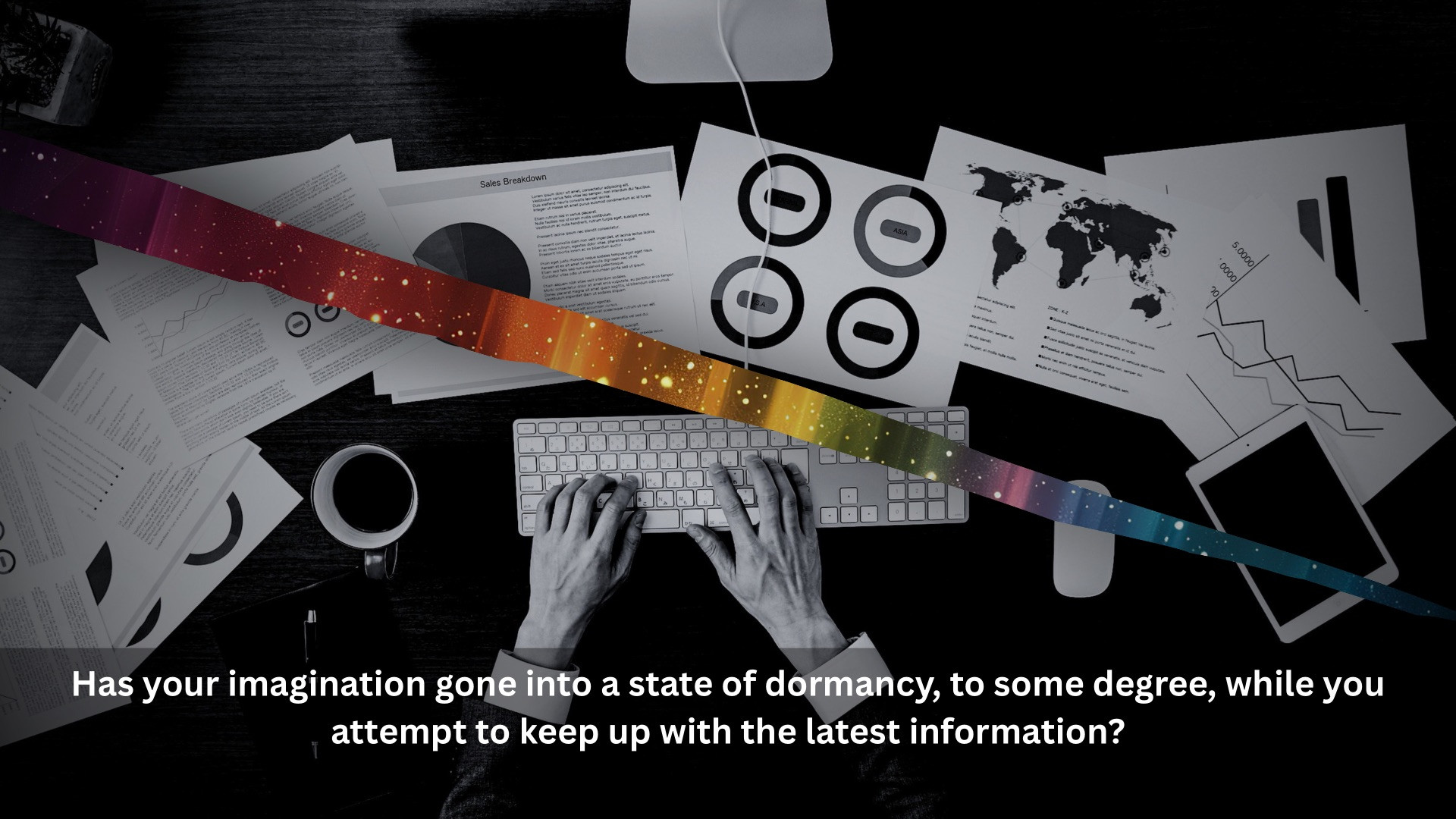
Moving forward will require new ideas not just a rehashing of what is already known. The unknown beckons for creative ideas that have never been recorded as information as yet. Imagination will always be the most valuable human asset for creating movement into new territories of knowledge. Recorded data cannot and will not provide new directions, but rather only recapitulate what is already known.
When AI becomes the norm of the future, will the curiously imaginative human still be around? Or, will information suffice and imagination suffer?
“The true sign of intelligence is not knowledge but imagination.”
Albert Einstein
A Figment of the Imagination
What if something seems real but does not actually exist? What if an idea, an experience, or fear is entirely fabricated to be knowledge. Is this where we are in 2026? Remember, information is not knowledge without a context.
AI seems to cater to the idea that it is built on imagination. Is this true, or is AI a figment of the imagination?
We can build data bases with trillions of bits of information, and this is what we are doing, but this is not knowledge. And, it will never be knowledge.
Imagination is the oil that lubricates the machinery of knowledge. When knowledge and imagination become symbiotic, it is no longer a figment of the imagination but rather a copacetic creation for human growth.
References
1-Merriam-Webster (2026). Definition of imagination.
2-Reddit (2026). How many books per year do people read?
Counselling with a client-centred focus
Our experienced psychologists work on an individual need’s basis, creating a safe, relaxed and welcoming space, where you can feel free to be yourself. To book your in-person session, please reach out to our friendly team today.
Contact Us